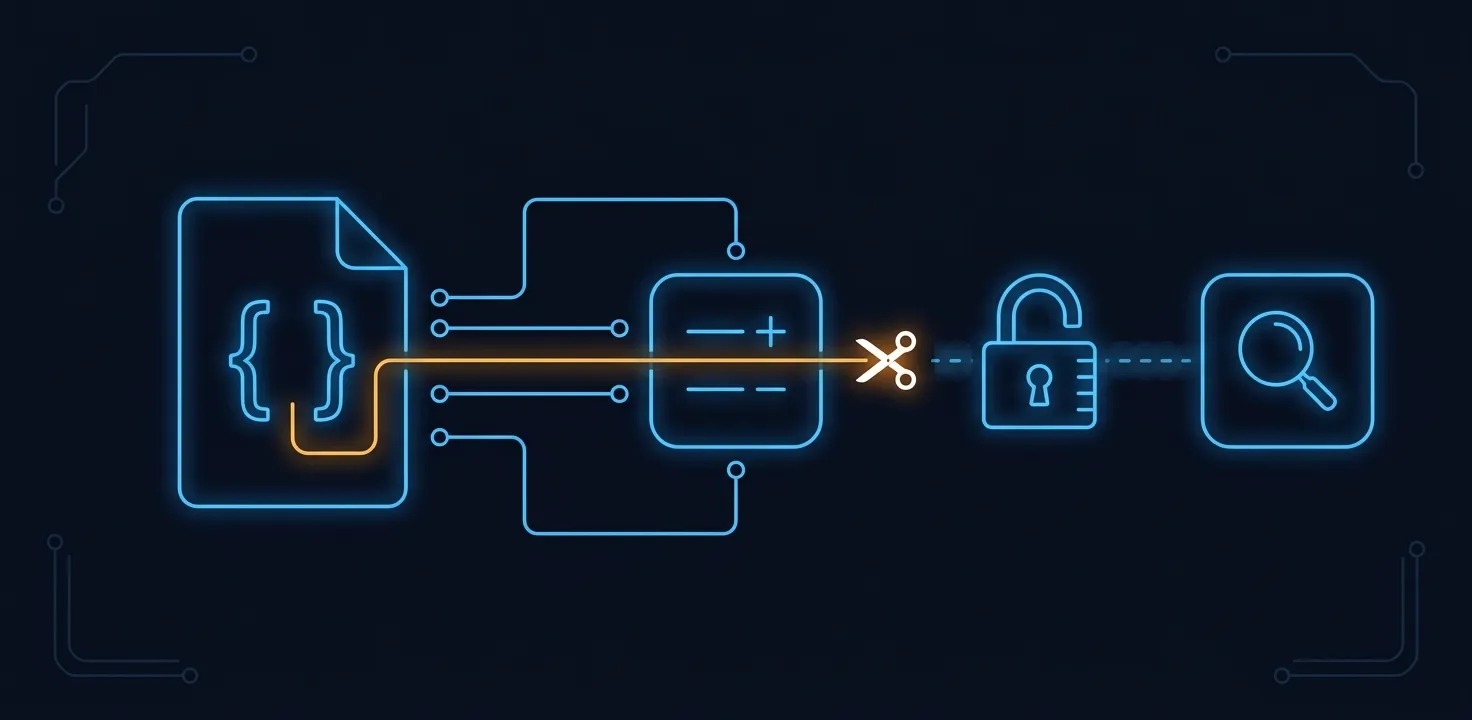
What Xcode's new JSON project file means for security (Part 2)
This is the second part of the “What Xcode’s new JSON project file means for security” series. In the first part of the series we went over the good news, that there’s a canonical byte form and Xcode already writes it, and the 4 places where your tooling and Xcode disagree about what’s in the file. That one was about parsing the file correctly, this one is about what’s worth looking at once you can.
In this second and final part I’ll go over:
- The 5 things in a project file that run a program on your machine, and the one everybody will miss
App.xcodeproj/project.xcproj binary, one line in.gitattributes, and every future diff isBinary files differxcodeproj target phase add-scriptdeleting an exclusion nobody asked it to touch, and shipping the file that was excluded
What can hurt you in a project file
Most of a project file is inert, paths, groups, localization settings and the bulk of the build settings can’t hurt you. The part that can is small enough to write down on one screen, and these 5 run a program during the build:
- Script build phases:
targets[].build-phases[]with"kind": "script", theshellandscriptfields - Build rules with a script:
targets[].build-rules[], theprocessorandscriptfields - External build system targets:
"kind": "external-build-system", with abuild-tool-pathandbuild-tool-argumentsthat can point anywhere - AppleScript build phases:
"kind": "apple-script"(yes, those are still a thing) - SwiftPM build tool plugins:
dependencies[]with"product-type": "build-tool-plugin"
That last one is the easiest to miss by a mile, one unremarkable line in a dependency list, no script anywhere near it, and the code it runs lives in somebody else’s repo. It’s not exotic either, zoonk depends on swift-openapi-generator exactly that way:
{ "kind": "package", "package": "swift-openapi-generator", "product-name": "OpenAPIGenerator", "product-type": "build-tool-plugin" },Then there’s the stuff that moves the trust boundary, package repository URLs and version constraints, local package paths, xcconfig references and cross-project dependencies. None of that runs anything by itself, it just changes whose code you end up compiling. And then the settings that switch off a protection you already have, ENABLE_USER_SCRIPT_SANDBOXING (which is what wraps your run-script phases in a sandbox), the OTHER_*FLAGS family, the code signing settings and ENABLE_HARDENED_RUNTIME, where the dangerous change is a value, not a new line, so a diff that adds nothing can still take a protection away.
That’s not a theoretical list of places a program could hide, the build phase and the build rule are exactly where XCSSET puts its payload.
Pulling just that subgraph out is what makes it readable by a human:
| Project | Raw lines | Security-relevant items |
|---|---|---|
| VirtualBuddy | 1100 | 15 |
| Secretive | 771 | 1 |
| zoonk | 288 | 7 |
VirtualBuddy’s 1100-line project file comes down to 15 things, 3 run-script phases, 9 package pins and 3 xcconfig references, and you can read all of them in under a minute. Secretive’s 771 come down to one.
One tuning note, and this one cost me a rewrite. My first version also pinned every security-relevant build setting, which gave me 113 items for VirtualBuddy, 80 of them stable signing configuration repeated per target per build configuration. A tool that asks you for 80 approvals gets 80 rubber stamps, and the 3 items that mattered end up no safer than before, so those settings get watched for dangerous values instead and nobody gets asked to approve them.
project.xcproj isn’t the whole bundle
Schemes are the big one, and they aren’t in project.xcproj at all. Scheme pre-actions and post-actions live in App.xcodeproj/xcshareddata/xcschemes/*.xcscheme, they’re XML, they’re committed by convention and they travel with a clone. What runs is an ExecutionAction whose ActionContent carries a scriptText attribute, a shell script sitting inside an XML attribute, and it fires when the scheme’s action runs. Pre-action output isn’t shown in the build log by default.
None of the new format’s readability improvements touch any of that, it’s a different file in a different language. Same story for .xcconfig files, which can set any build setting from outside the project, including the ones that turn off the script sandbox, and Package.resolved, which pins the exact revision of every package that gets compiled.
So a check that covers project.xcproj and stops there has left a well-known door open.
A repository can revoke its own reviewability
Everything good about this format for security depends on one thing, a change producing a diff a human can read. But that property is granted by git, not by the format, and a repo can take it away from itself with one line in .gitattributes:
App.xcodeproj/project.xcproj binaryA change that normally renders as 4 insertions, 3 deletions with full context comes out like this instead:
 App.xcodeproj/project.xcproj | Bin 10570 -> 10627 bytes
 Binary files a/App.xcodeproj/project.xcproj and b/App.xcodeproj/project.xcproj differ
57 bytes bigger, and that’s everything the review is going to tell you about that change. -diff and -text do the same thing, and linguist-generated is the soft version, GitHub keeps the diff and folds it behind a click nobody clicks.
This works because .gitattributes is short, boring and already full of entries that look just like it. I’m guessing that line sails through a pull request a lot more comfortably than a new run-script phase does, and it switches off the review that would’ve caught that phase. Git honours a .gitattributes in any directory too, so one dropped next to the .xcodeproj is even less likely to be read.
And that’s the part that bothers me the most. Nobody has done this to a project.xcproj as far as I know, and this is still a beta, but the mechanism is sitting right there: the kind of injection XCSSET has been shipping for 6 years used to get through review because nobody could read a .pbxproj diff, this format finally gives a reviewer a fair shot at catching it, and then one line, in a file nobody reads with any suspicion, takes that shot away again.
The xcodeproj CLI, and a bug in it
Xcode 27.2 also ships xcodeproj, a first-party CLI that reads and writes project files, and I didn’t find it in the Xcode 27.2 beta release notes. Here’s what it does:
xcodeproj setting set <KEY> <VALUE> [--target T] [--config C]
xcodeproj target phase add-script --target T --name N --script S
xcodeproj target add | add-aggregate | add-dependency | remove
xcodeproj group add | add-file | include | exclude | remove
So modifying a project doesn’t require parsing anything anymore, which matters if your detection logic assumes project files are only written by Xcode. And xcodeproj setting set ENABLE_USER_SCRIPT_SANDBOXING NO takes the sandbox off every run-script phase in the project, in one command, from a binary that’s signed and notarized by Apple. Whatever you have watching for odd tools touching project files isn’t going to blink at that one.
While testing that CLI I found a bug. Running add-script against zoonk’s project at commit 0445f26, about as boring an edit as you can make:
xcodeproj target phase add-script \
    --project Zoonk.xcodeproj \
    --target Zoonk \
    --name "Lint" \
    --script 'echo hi'
That adds the phase you asked for and deletes an unrelated entry from a synchronized folder’s exclusion list in the same write, with nothing in the output to say so:
  "exclusions": [
    "Info-Debug.plist",
    "Info.plist",
-   "Resources/StoreKit/Subscriptions.storekit",
  ]
What it does say is Added script build phase named 'Lint' to target 'Zoonk' at index 4. and that’s the whole report!
Subscriptions.storekit had been deliberately excluded from that target, so it now joins the target and gets copied into the shipped app bundle. Put a credentials plist or an internal config file in there instead and you’ve shipped it. It reproduces every time on 27B5019i, and I’ve written it up for Apple through Feedback Assistant.
The file it wrote is still byte-identical to xcprojformatter output, so the canonical form check from Part 1 passes it. What catches it is the diff, one deleted line, which in the old .pbxproj nobody was ever going to spot. The format is working exactly as intended here, which is a strange thing to say about a bug that widens what ships in your app.
So what should you do?
A ladder, cheapest first, and the cheap rungs carry most of the weight. First one is CODEOWNERS, today, for free:
*.xcodeproj/project.xcproj          @your-org/appsec
*.xcodeproj/xcshareddata/xcschemes/ @your-org/appsec
*.xcconfig                          @your-org/appsec
Package.resolved                    @your-org/appsec
.gitattributes                      @your-org/appsec
.gitattributes is on that list on purpose, it’s the file that can switch off everything else. Add a branch protection rule requiring Code Owner review and that’s the whole control, no tool, no keys, no false positives, and it’s enforced server side where a compromised laptop can’t reach it. In my opinion there’s nothing else in here that buys you this much for this little work.
The other 3 rungs, in order:
- Look at a project before you build it. Against a repository you have no history with there’s no baseline, so the question isn’t whether it changed, it’s what it does at all, so read the script phases before you press Build.
- A committed manifest of the executable surface, verified in CI, so changing a script phase means changing 2 files and the second is small enough somebody will read it.
- Signatures, and only with user presence. Ed25519 detached signatures with
ssh-keygen -Y signand-Y verifyagainst a committedallowed_signersfile, never HMAC, because a shared secret has to exist wherever verification happens, so every verifier is a forger too.
But be honest about what that last one buys you. Against malware already running as you, on your machine, it buys much less than it looks like, anything you can sign without a prompt it can sign too, it injects, re-signs and verification passes. What signing protects is everybody downstream who pulls, and CI, because CI isn’t the attacker’s machine. That’s also why user presence matters, a key that can’t sign without somebody touching a sensor means the malware can’t get a signature without making noise.
What I wouldn’t build
An Xcode plugin that checks a project before it opens or builds it. That’s the obvious shape, it’s the first thing I looked into, and it can’t be built. XCSourceEditorExtension is the whole supported extension surface and its entire public API is 4 types that work on a text buffer, you get buffer lines and a completion handler. It’s never told which file it’s editing, it gets no project or workspace reference, it has no lifecycle event for project open or for build, and no way to say no. The DVTPlugIn era ended with Xcode 8, and the “plug-ins” new in Xcode 27 are agent plug-ins that add skills and MCP servers to the coding assistant, nowhere near the document lifecycle.
So the gate has to live outside the IDE. Gating open and build instead of commit and merge means an Endpoint Security system extension, and that’s a restricted entitlement from Apple, notarization and MDM deployment, so it’s a real project and not a weekend one.
And Xcode still has no project trust prompt. VS Code has Workspace Trust and JetBrains has trusted projects, but in Xcode cloning a repo and pressing Build just runs what’s in it. The JSON format didn’t change that either way.
Conclusions
- Almost all of the security benefit here is reviewability, not anything cryptographic, and one line of
.gitattributesswitches it off, so.gitattributesbelongs in CODEOWNERS right next to the project file. - The list of things inside a project file that can run code is short, 5 kinds, and the one people will miss is the SwiftPM build tool plugin, it looks like a dependency and there’s no script in sight.
project.xcprojisn’t the whole bundle, schemes, xcconfig files andPackage.resolvedare all outside it and none got easier to read.- Apple’s own
xcodeprojCLI deleted an exclusion nobody asked it to touch, and the file it wrote is still canonical, so a byte level check says it’s fine. - Sadly nothing here stops malware that’s already running as you, CI is where that gets caught, because CI isn’t your laptop.
- If you only do one thing, make sure the right person reads the diff.
If you see an error or have any questions, please reach out @ivMobAppSec.